Notes
The (LinkedIn) Creator Business Model: a breakdown of the different monetization routes
Alright, alright, alright. It is time to shed some light on how creators earn their keep online.
Before we begin: what's your talent, your expertise, your story, and what can you monetize?
Is it consultancy? Is it coaching? Is it resume writing? Is it sales?
Before you even think about branding or anything, you need to pick the thing you already know how to do, that someone else will pay for.
Then you brand, craft an offer, create a content strategy, and you start fighting in the LinkedIn trenches.
You set up the funnel:
- Get a website or portfolio
- Have a lead magnet or two
- Have a consultation call booking link
- Configure your customer onboarding flow
Etc.
And THEEEEEEEEEN you start feeding the content machine.
You post. You grow your audience in time. Five, ten, twenty thousand followers in as little as a year.
Now what?
Well, most people stall now. They've built the audience and they're still selling one thing, to one person, one at a time. So let's talk about all the different ways you can monetize once you have an audience. It can be as small as a couple thousand followers.
Before I continue with the list.
Your services are your core offering, at least in the beginning, so everything else, including your infrastructure, is centred around that, as well as your positioning.
Your core services pay you while everything else is still being built.
As you begin to grow, you may lean more into brand partnerships, or you start a community, or you go heavy on digital products. But you cannot do all of them. Not well, and not at the same time. At least not alone.
So for each of these I've included the effort level, what it costs you in capacity, the output math, and the pros and cons. Please read them against your own week, not against someone else's revenue screenshot.
Here's the much awaited breakdown.
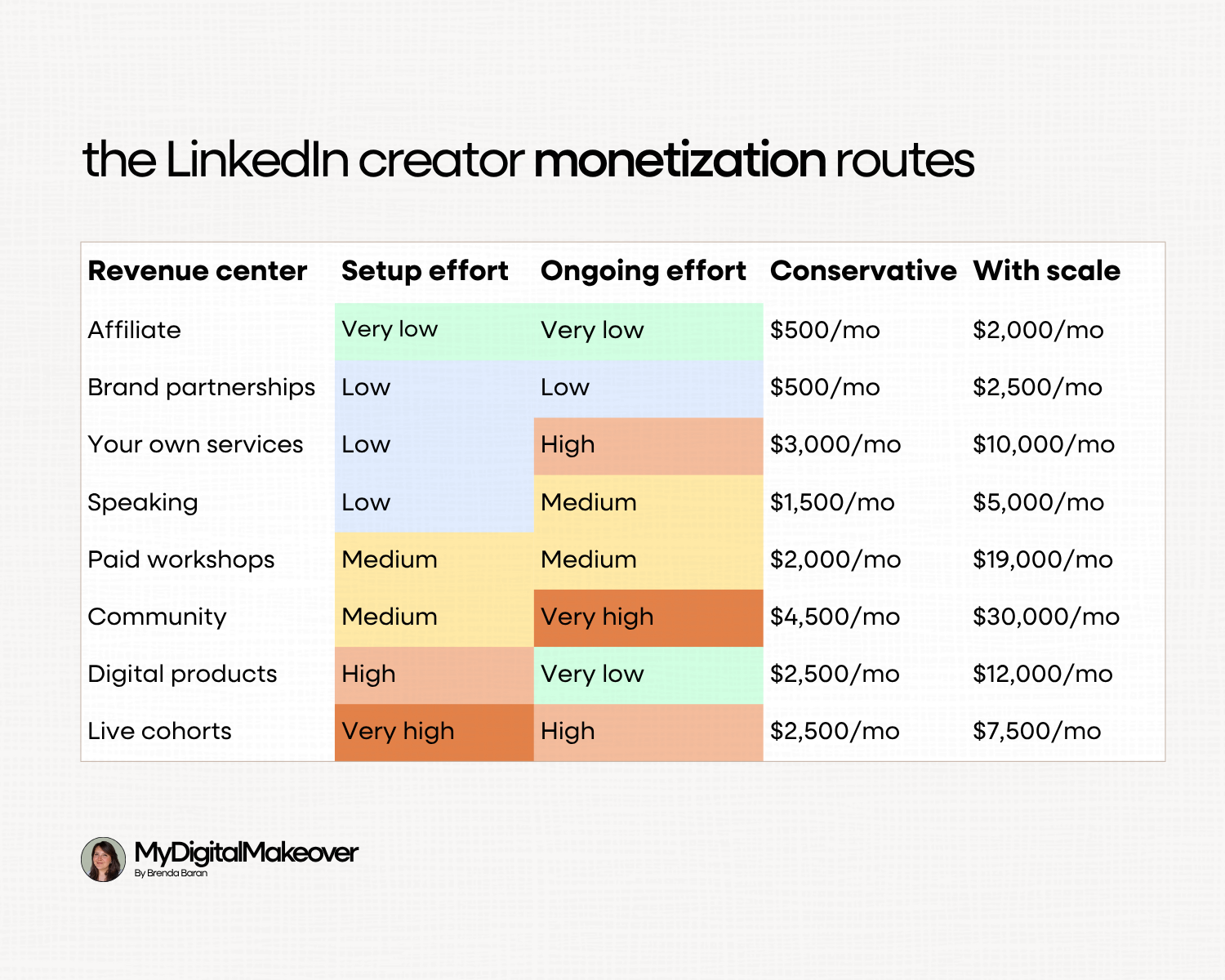
01
Your own services
- Effort
- Low to set up, high to sustain, as you scale.
- Capacity
- You can start this week with a calendar link and a payment page. But every hour sold is an hour worked, so it caps out at whatever you can personally deliver.
You can have a couple of core offerings, or more, depending on what you like to do.
Some people run one signature package and nothing else. Some people run a ladder: a low-cost entry point, a mid-tier package, and a done-for-you engagement at the top. This works amazingly well.
The math
- A Consultation hour at $300 × 6 per month = $1,800/month
- B 3-session coaching package at $900 × 4 per month = $3,600/month
- C Two DFY (done-for-you) projects at $2,500 = $5,000/month
That's roughly $10,000 a month without a single other revenue center switched on. Yes, Susan, 10k months are absolutely possible. Stop limiting your beliefs.
Pros
- Fastest path to revenue with no product build
- You learn exactly what people will pay for, which feeds everything else on this list
- Highest margin per hour when you price properly
Cons
- It stops when you stop
- Delivery eats the time you need for content and for building the other centers
- You hit a ceiling, no matter how big the audience gets, unless you scale and hire
02
Brand partnerships
- Effort
- Low to set up, low to sustain, high to land the first one or two.
- Capacity
- A few hours a month once it's running. Most of the work is pitching, not delivering.
When you're delivering services, you're using tools, every single day.
Schedulers, CRMs, design tools, AI tools, payment, and so on.
You can partner up with these people. Sponsorships, ambassadorships, straight payments for content.
The thing people get wrong here is waiting to be approached. You absolutely do not wait. You pitch the tools you use, with your numbers and your audience fit attached.
The math
- A Sponsored post at 10–20K followers: $500–$2,000 per post, sometimes more if you have a really engaged audience
- B Ongoing ambassadorship: $1,000–$2,500/month retainer
- C 2 sponsored posts a month at $750 = $1,500/month
Pros
- Almost no build required, you're already using the tools
- Retainers make it predictable
- It compounds with audience growth without much extra work
Cons
- You don't control the timing or the budget cycles
- Too many sponsored posts and your feed stops feeling like yours
- Your credibility is the collateral, so one bad tool costs you more than it pays
03
Community
- Effort
- Medium to set up, very high to sustain.
- Capacity
- This is a real weekly commitment. Calls, moderation, prompts, showing up. Do not start one if your week is already full.
This one only works if you are really, genuinely offering value. Communities die fast when they're built as a revenue play first and a room second.
But when it works, it's the most stable income on this entire list, because it's recurring.
The math
- A 1,000 members × $30/month = $30,000/month
- B 1,000 members × $50/month = $50,000/month
- C More realistically, to start: 150 members × $30/month = $4,500/month
You do not need a thousand people on day one. A hundred and fifty paying members who show up and engage in the space you set up for them is pretty good business.
Pros
- Recurring and predictable, which nothing else here is
- Your members become your case studies, your referrals, and your testimonials
- It's the warmest audience you will ever sell anything else to
Cons
- Churn is releeeeentless, and you're always refilling the room
- It's the hardest one to step away from, even for a week
- Slow to start, and a quiet, cricket-like community is worse than no community
04
Speaking
- Effort
- Low to set up, medium to sustain.
- Capacity
- Lumpy. A booking costs you a day for prep and delivery, plus travel if it's a stage.
You can get booked for webinars. You can get booked to speak in other people's communities. You can book live events and speak on stage, if that's your cup of tea.
This used to be treated as exposure. It's not. For a lot of creators out there, it's a revenue center.
The math
- A Guest webinar or community session: $500–$2,000
- B Corporate webinar or internal training: $1,500–$5,000
- C Conference stage: $2,500–$10,000+
- D One booking a month at $1,500 = $18,000/year
Pros
- You get paid to be in front of someone else's audience
- Each talk becomes content, clips, and a digital product
- Positions you as the expert much faster than a year of posting
Cons
- Inconsistent, and largely outside your control
- Prep time is almost always underestimated
- Plenty of organisers will still try to pay you in exposure
05
Digital products
- Effort
- Moderate–high to set up, very low to sustain.
- Capacity
- Front-loaded. Block real time to build it, then it costs you almost nothing.
This is one of the most important ones.
As you grow, you can create guides. You can write a book. You can create a workbook, or anything you can put your name on and start directing traffic to and selling. You can record a webinar and sell that, or set up an async course. Loads of options.
These are great because of their versatility. They can be used as lead magnets, and they can also be used as products in themselves. They're multipurpose, babyyyy. We love these.
The math
- A Guide at $47 × 60 sales/month = $2,820/month
- B Workbook or template pack at $27 × 100 sales/month = $2,700/month
- C Prerecorded course at $297 × 25 sales/month = $7,425/month
You build it once, and it sells while you're asleep, on a call, or on holiday, provided you have an awesome content strategy or you direct traffic via ads.
Pros
- Fully decoupled from your time
- Doubles as a lead magnet, so it works even when it isn't selling
- Scales infinitely with no extra delivery cost
Cons
- The build is longer than you think, and it's unpaid the whole way through
- A low price means you need volume, which means traffic
- Easy to build something nobody asked for. Make sure you do lotsa research
06
Paid workshops and webinars
- Effort
- Medium to set up, medium to sustain.
- Capacity
- Roughly two weeks of promotion for ninety minutes of delivery. Repeatable once you've done an initial run and you have your mise-en-place done.
These are the easiest thing to sell to an audience that already knows you, because the commitment is small and the outcome is specific.
The math
- A 200 people × $95 = $19,000 from one session
- B 50 people × $95 = $4,750 from one session
- C Run one a month at 50 people = $57,000/year
And the recording becomes a digital product. So you get paid two different ways for the same ninety minutes.
Pros
- Low buyer commitment, so it converts well from a cold-ish audience
- You can validate a full course idea in one session
- The asset it leaves behind sells forever
Cons
- You're doing a launch every single time, and they can be tiresome
- Registration is not attendance, and no-shows are brutal
- One-to-many delivery still means live delivery
07
Live cohorts and courses
- Effort
- Very high to set up. High to sustain.
- Capacity
- Curriculum build, plus live weeks where you should not be taking on client work. Plan around it.
This is the step up from a workshop. Multiple sessions, a defined curriculum, a group going through it together, with a start and an end date.
Live cohorts are priced higher than anything prerecorded because you're in the room. People aren't just buying the material. They're buying access to you, and to the other people in the cohort.
The math
- A 25 seats × $1,200 = $30,000 per cohort
- B 3 cohorts a year = $90,000/year
- C Smaller and tighter: 12 seats × $750 = $9,000 per cohort
And then, once you've run it live two or three times, you record it. It becomes an evergreen course and drops into digital products, selling on its own forever.
Pros
- Highest revenue per launch of anything on this list
- Results are usually great if you deliver, and you get loads of testimonials
- It turns into an evergreen asset after two or three runs
Cons
- The heaviest build of all eight
- Cohort weeks swallow your calendar entirely
- Refund and completion expectations are high at this price point
08
Affiliate
- Effort
- Very low to set up, very low to sustain.
- Capacity
- An afternoon, literally. This one you can start today.
You can get links that you send to people, or put on your website, and direct traffic through.
They get a discount, and presto, you get paid.
You can do this pretty early on, before you have a product, a course, before you have anything. If you're already recommending a tool in your DMs, you may as well be paid for the recommendation.
Just don't recommend anything you wouldn't recommend to a friend. Recommend stuff you use and like.
The math
- A 20 conversions/month at $25 recurring commission = $500/month, recurring and compounding
- B One-off software commissions at $50–$200 per sale
- C Course or program referrals at 30–40% of a $500 product = $150–$200 per referral
Pros
- Nothing to build, nothing to deliver, no support burden
- Recurring commissions compound in the background
- Works at any audience size
Cons
- Small money unless you're driving loads of volume
- You don't control the product, the price, or the support experience
- Overdo it and you look like an affiliate account rather than an expert
-
AffiliateVery low
-
Digital productsVery low
-
Brand partnershipsLow
-
SpeakingMedium
-
Paid workshopsMedium
-
Your own servicesHigh
-
Live cohortsHigh
-
CommunityVery high
The two with the lowest ongoing effort, digital products and affiliate, are the two with the highest setup cost or the lowest ceiling.
You pay somewhere, always. The question is only whether you pay upfront or forever.
So what do you build, and when?
-
Start
Services, plus affiliate links for the tools you already use.
-
Once you have proof
Digital products built from the questions clients keep asking, and brand partnerships pitched off your growth.
-
Once you have volume
Paid workshops, then speaking.
-
Once you have a system
Live cohorts, and then community last, because it's the one you can't put down.
Please remember you are not meant to run all eight alone. Nobody runs all eight well.
Pick two or three that match your capacity and what you like doing, and build the digital ecosystem underneath them properly.
What's coming
Idk. I'm very passionate about the creator economy, particularly for creators monetizing on LinkedIn.
But I'm also very busy with branding + web projects, so I never know for certain when I'll post long-form content again.
See you in the next one, whenever that is.
Bren